
Zone · Guides · Choosing an outdoor security light
How do you choose an outdoor security light?
Decide three things: what turns the light on, where the light needs to land, and whether the exact model is rated for that spot. “Wall pack” and “jelly jar” are fixture shapes; “motion” and “dusk-to-dawn” are controls. You choose each one separately.
Before wiring, turn off power at the breaker; follow local code; use a licensed electrician if unsure. Follow the instructions for the exact light or connector.
Start with what turns it on
A dusk-to-dawn light has a photocell that switches it on when it gets dark and off when it gets light. A motion light switches on when something moves in front of its sensor. Some lights do both, so read the model’s controls instead of going by the product name. And remember that how far a sensor “sees” is not how far the lamp lights up.
Match the shape to the job
- A wall pack is a fixed box on the wall that throws light down and out. Check its beam and the mounting instructions.
- A jelly jar is a small fixture with a jar-shaped glass or lens, common beside doors. The shape tells you nothing about brightness or weather rating.
- An adjustable-head flood lets you point each head at a different area, such as the drive and the side gate. Where you aim it matters as much as its lumen number.
- An area light is built to light a wider space like a yard or parking area. A lumen figure still won’t tell you how many feet it covers.
Zone models to compare
| Zone light | Output | Control | Published location |
|---|---|---|---|
| Dusk-to-dawn wall packZ-WP150-DC | 15,000 lm | Dusk-to-dawn photocell | Indoor and outdoor use |
| Dusk-to-dawn jelly jar security light, blackZ-JW1000-B-DC | 1,000 lm | Dusk-to-dawn photocell | IP54: dry, damp and wet locations |
| Dusk-to-dawn area lightZ-XY-BL50-CCT | 5,000 lm | Dusk-to-dawn photocell | Wet locations, indoors and outdoors |
| Dual-head motion security flood light, blackZ-3SH-MA-BLK | 3,000 lm | Motion sensor, up to 30 ft; on time 1, 5 or 12 min; dusk-to-dawn mode | Outdoor installation only |
| 2-head motion security lightZ-S-2500-BZ | 2,500 lm | Motion sensor, on time 3 s to 7 min | Outdoor use |
These are the specifications and features published for each exact model on its linked product page. “Not published” is an information gap, not a rating or a “no”.
Check the installation before buying
Look at the wall or pole you’re mounting on, the power you have there and the model’s instructions. Ask whether rain can hit the fixture directly or whether it sits under an eave; those are different conditions, and the location rating in the table tells you which one each model is meant for. “Outdoor” on the box is not an IP rating. Plan the aim so the light lands where you need it and not in your neighbour’s windows.
The table shows what each light is listed with. It can’t promise how much area you’ll cover or how secure the spot will feel. If a number you need isn’t there, ask for it before you buy.
Where people walk, where light lands, what you see
Sketch two things on a plan of the house: the spot that needs light, and the path someone takes to reach it. A motion sensor has to pick up movement along that path. The fixture has to throw light onto the spot. Often they overlap, but not always, and a wide sensor won’t help if the light is pointed somewhere else.
Then think about how the light looks from the doorway, from next door and from inside your house. A light aimed down at a driveway does a different job from a bright lamp shining at a window. The lens, the housing and how far the head can tilt all change the result. More lumens alone won’t fix a light that spreads the wrong way.
Decide how each light should run
A front entrance you use every evening needs something different from a side path you walk once a week. Some spots want light all night, some only when someone shows up, and some are just for looks. Work out which one each spot needs before you compare models. That way you won’t end up with the right shape and the wrong control.
Then look at brightness, light colour and installation together. A warm light at the front door and a cooler, brighter light over a work area can both be the right call. If a setting, dimming option or performance number isn’t listed for a model, treat it as unknown for that model. Don’t borrow the figure from a similar light.
Common questions
What is the best outdoor security light for a driveway?
Usually a motion light with heads you can aim, mounted where it looks down the length of the drive and catches the approach from the street. If you want the drive lit all night, choose dusk-to-dawn instead, or a light that offers both. The brightest model isn’t automatically best; a narrow drive with a car parked in it needs aim more than raw output.
Is a flood light the same as a security light?
Not quite. “Flood” describes a wide beam. “Security” describes what you use it for. A flood can be switched by hand, by motion or by a photocell, depending on the product. The word “flood” on its own doesn’t tell you the sensor range, beam angle or whether it can stay on all night.
Can an outdoor wall lantern work as a security light?
Yes, at an entrance. Whether it does the job depends on its brightness and its control. Some lanterns have a motion sensor or photocell and some don’t, so check the listing rather than choosing on looks alone.
Should a porch light stay on all night?
That’s up to you. If you like the entrance lit whenever it’s dark, a dusk-to-dawn light does it without anyone touching a switch. If you’d rather the light come on as you arrive, use motion. Either way, the light still needs to land on the steps and door.
Is every outdoor light rated for rain?
No. Some outdoor lights are only meant for covered spots like a porch ceiling, while others can take direct rain. Check the location rating for the exact model, and check the mounting and wiring requirements at the same time. The word “outdoor” is not an IP rating.
Can I pick a motion light by its sensor angle alone?
No. The sensor angle is one part of detection, and detection is one part of the job. Which way people approach, what’s in the way, the listed range and how far you can adjust the sensor all matter. Brightness and beam spread are a separate question, however wide the sensor sounds.
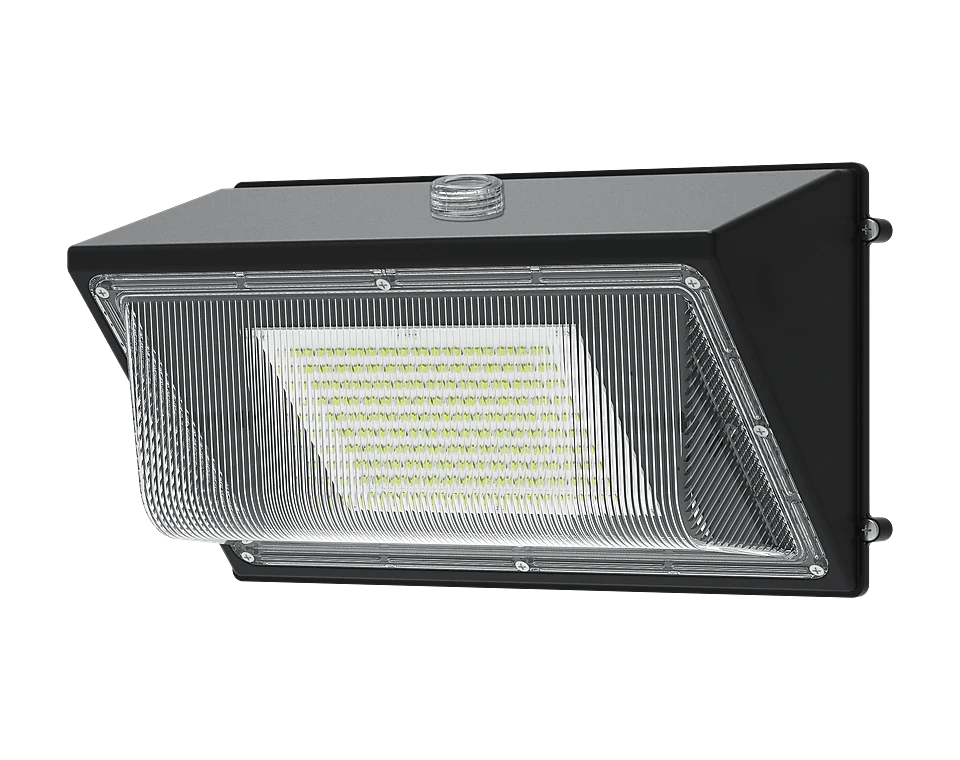
Dusk-to-dawn wall pack
Dusk to dawn · 5000K daylight
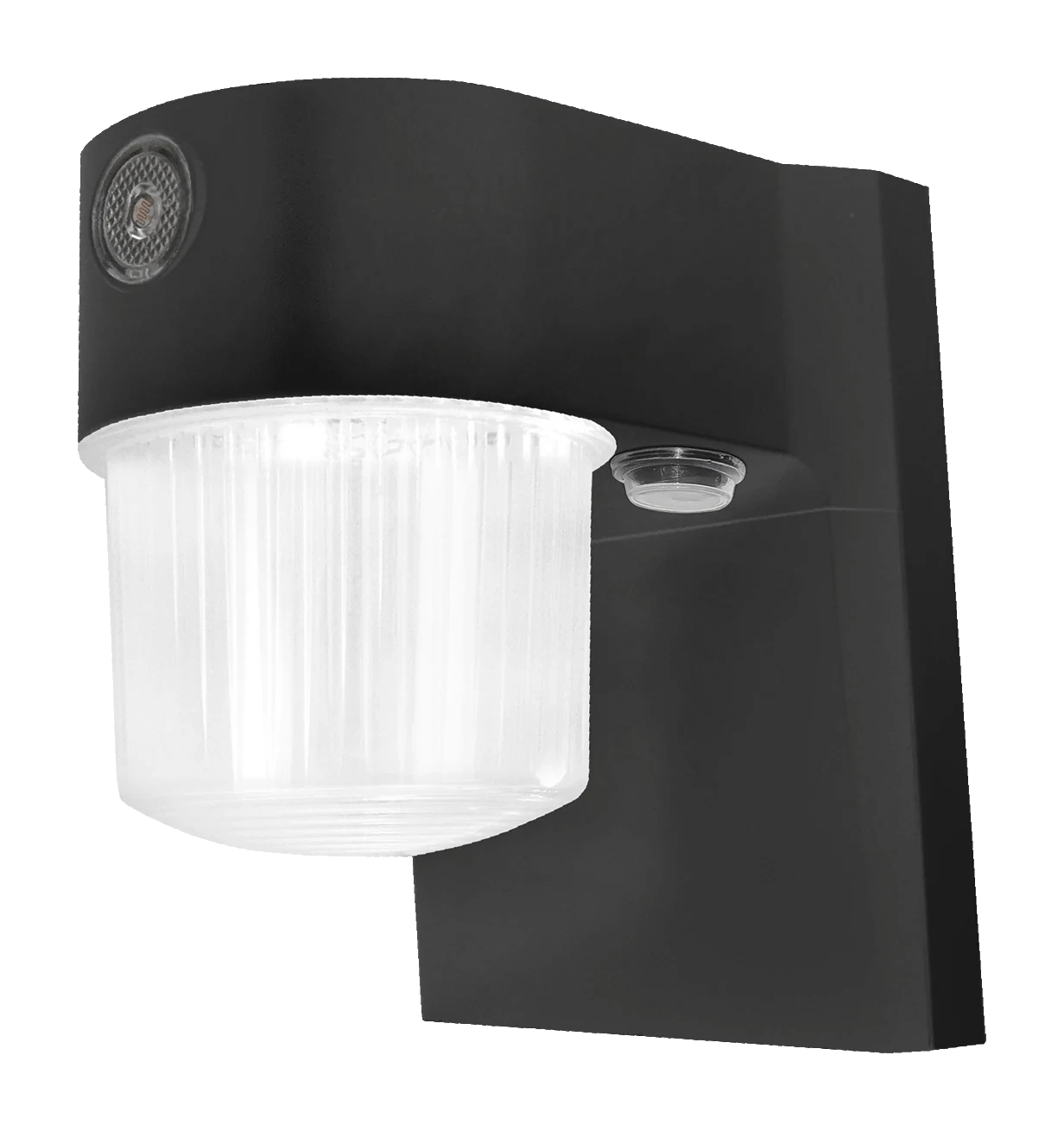
Dusk-to-dawn jelly jar security light, black
Dusk to dawn
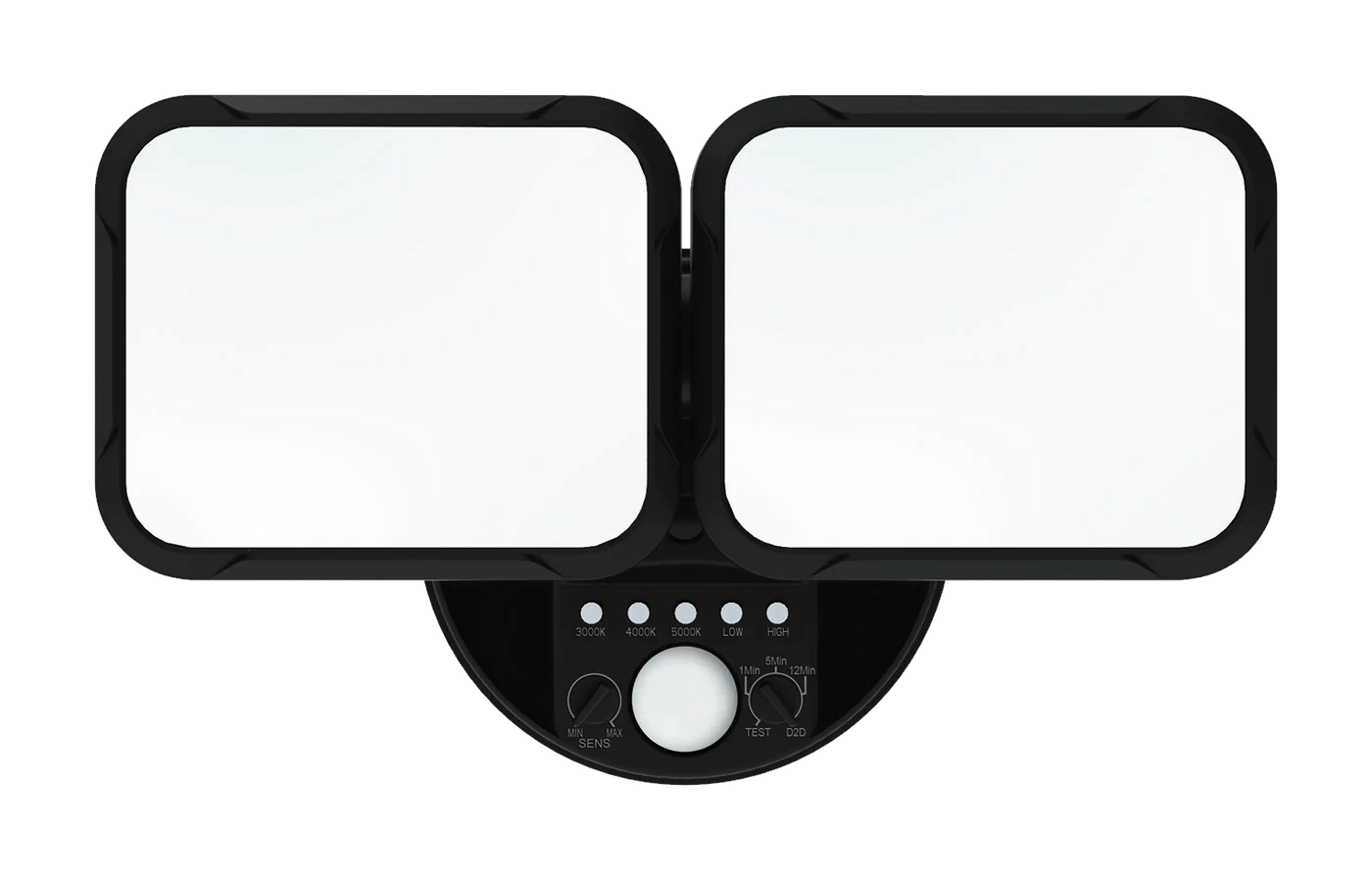
Dual-head motion security flood light, black
2 heads