


Zone · Guides · What AWG means
What does AWG mean on wire and connectors?
AWG stands for American Wire Gauge, the US system for sizing wire. The smaller the number, the thicker the wire: 12 AWG is thicker than 14 AWG.
Before wiring, turn off power at the breaker; follow local code; use a licensed electrician if unsure. Follow the instructions for the exact light or connector.
Gauge is not the outside diameter of the cable
The gauge is the size of the metal wire inside, not the insulation around it or the whole cable. A cable with three wires and an outer jacket is much fatter than any one wire in it. Solid and stranded wire can share the same gauge number but are built differently, so a connector has to suit the wire type and metal as well as the size.
How do you read a connector range?
A range like 22–14 AWG gives the smallest and largest wire the connector is made for. Remember the numbers run backwards: 14 AWG is the thick end and 22 AWG the thin end. The range doesn’t mean any bundle of those sizes will work. Check the chart on the package for which combinations and how many wires each cap takes.
Zone examples
| Zone connector | Wire range | Published listing | Pack counts |
|---|---|---|---|
| Blue compact wire nut, low profileP2 | 22–14 AWG | UL 486C · 300 V | 1000 |
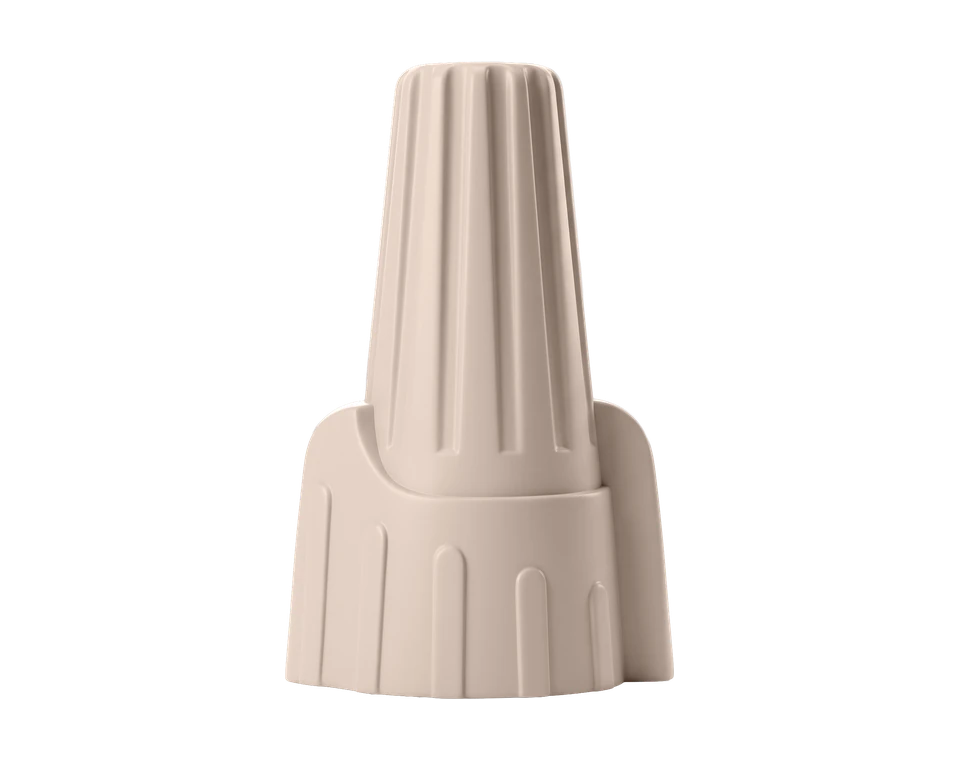
| Yellow winged wire nutP11V | 18–10 AWG | UL 486C; UL 486C · 600 V / 1000 V | 500 / 1000 / 100 |
| Green grounding wire nut, with holeP99 | 14–10 AWG | UL 467 | 100 |
| 3-port lever wire connectorPC623 | 28–12 AWG | UL 486C | 50 |
Values come from each SKU’s published Zone listing. An AWG range does not specify the permitted number or combination of wires.
These four show why you can’t pick by colour alone. The blue P2 is a compact, low-profile cap with its own range; blue isn’t a universal code for one wire size across brands. The green P99 is a grounding connector, so it’s for ground wires only, whatever its size range.
Does AWG tell you the circuit rating?
No. How much current a wire can safely carry depends on the metal, the insulation, how it’s installed and your local code, not on the gauge number alone. A connector’s AWG range tells you which wires it fits. It doesn’t tell you what breaker to use, and we don’t give amp ratings for wire sizes here.
What about square millimetres?
Outside North America, wire is usually sized by its cross-section in square millimetres (mm²) instead of AWG. Some connectors, like Zone’s PC333 push-in connector, publish their range in mm². Check your wire against the range in the units the maker used. A rounded conversion to AWG is a rough guide, not a guarantee of fit.
Use the size chart as a starting point
The Zone wire nut size and colour chart lists every published range in one place. Use it to narrow the choice, then check the wire type, the combination chart, the location and the instructions for the part you pick.
Why gauge numbers run in the opposite direction
The system dates back to wire drawing, where wire was pulled through a series of dies to make it thinner. The more times it was drawn, the higher the number and the thinner the wire. That’s why 10 AWG is heavier than 14 AWG. The steps aren’t even, either. Going up three gauge numbers roughly halves the cross-section, so a gap of two gauge numbers isn’t two millimetres of anything.
To find a wire’s gauge, read the printing on its insulation or on the cable jacket. Common house cable is marked with the gauge and number of wires, for example 14/2 or 12/2. Don’t guess from how thick the whole cable looks, because insulation and jackets vary a lot.
Solid, stranded and metric descriptions
Solid wire is one piece of copper. Stranded wire is lots of thin strands twisted together, which makes it more flexible. Both use the same gauge numbers, but they behave differently in a connector: stranded wire can splay or bunch up, and some connectors handle it better than others. Check that the connector you pick says it takes the kind you have.
A metric size in mm² measures the area of the wire’s cross-section, not its diameter, so it isn’t the same as a measurement in plain millimetres. If a connector lists its range in mm², read it in mm². Converting gives you an approximate AWG size, but it doesn’t add a size the maker didn’t list.
Common questions
Is 12 AWG larger or smaller than 14 AWG?
Larger. 12 AWG is thicker than 14 AWG because lower gauge numbers mean thicker wire. That tells you the size only; it doesn’t tell you what circuit the wire is on or whether a given connector takes it.
Does AWG include the insulation?
No. AWG is the size of the metal wire only. Insulation thickness varies by type, so two wires that look the same size from the outside can have different gauges inside. Read the printing on the insulation.
Does 14 AWG stranded wire fit any 14 AWG connector?
Not always. The connector has to accept stranded wire as well as the size. Many twist-on wire nuts and lever connectors take both solid and stranded, but check the package before you assume.
Does 22–14 AWG mean I can mix any of those sizes?
No. The range gives the smallest and largest wire the cap takes, not every mix. How many wires, and of which sizes, can go in together is on the chart on the package.
Is a terminal’s stud size also its wire gauge?
No. On a ring or fork terminal, the stud size (like #8 or #10) is the screw or post the terminal fits over. The wire range is the wire you crimp into the other end. You need both to match your job.
Can I choose a breaker from a connector’s AWG range?
No. A connector range only tells you which wires fit. Breaker size depends on the wire, its insulation, how it’s run and your local code. If you’re not sure, ask a licensed electrician.